Sustainability is all but impossible if we have to condition the world, but it becomes easier and easier as we’re able to condition smaller pieces of it. Look carefully at the image below. Can you see the tractor-trailer rig on the bridge in the distance? The cab is barely visible, and the driver is microscopic. But Waffle House has the unenviable task of attracting that driver (and fellow-travelers on the bridge) to come for breakfast. So what do they have to do? Let’s take a look:
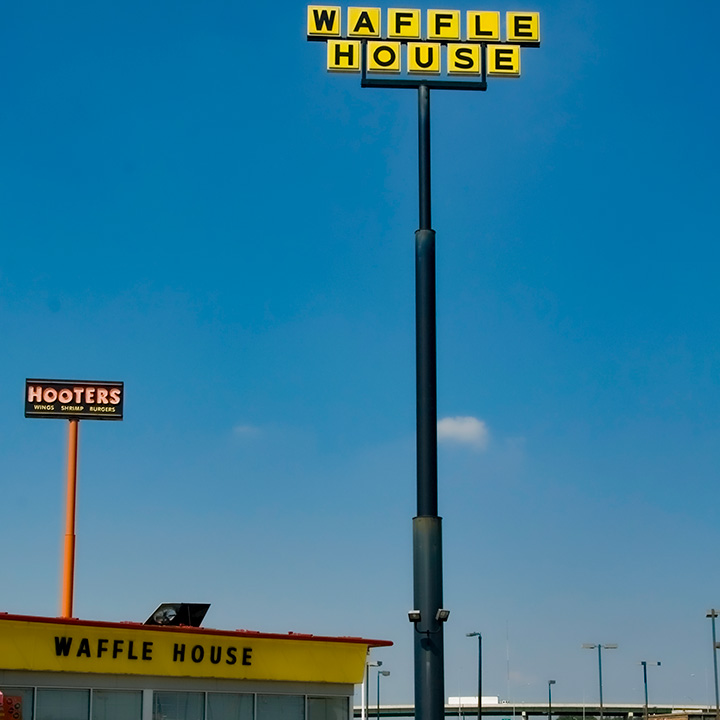
The first thing Waffle House is forced to do is to erect the two hundred foot tall sign that probably costs $200,000, because travelers at highway speeds will only be on the bridge for a few seconds, and if Waffle House doesn’t entice them to exit by then, they’ve lost their business.
Next, because their entire customer base arrives by motor vehicle, they must pave every square yard of their site not occupied by their building for parking to accommodate their customers’ cars (the semis must park on the street.) So is there any shadow of doubt why poor Waffle House has such ugly buildings? Of course not! They’ve completely blown their budget on the sign and the parking lot!
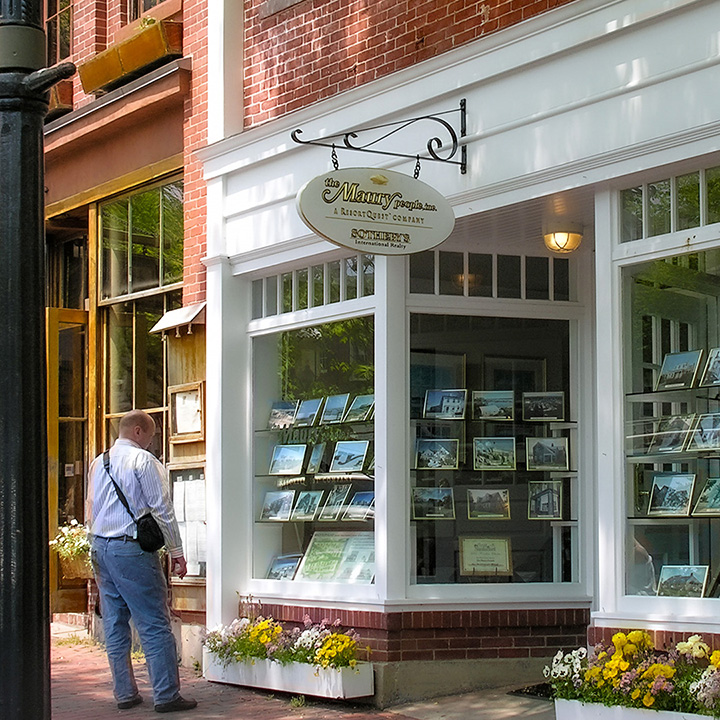
Contrast that with this shop on Nantucket. The man in this picture (who happens to be renowned New Urbanist Mike Watkins) arrived on foot to this storefront, and is standing less than ten feet from the sign, which was probably procured for something much closer to $200 than $200,000. Because this store doesn’t have to operate at a wide extent to attract customers, they’re able to spend their money on other things... like being able to afford high rent in a nice building on Nantucket. Which place would you rather be?
This issue, however, goes far beyond desirable places. Everywhere we look, there are problems that can easily be solved if we’re able to do it small, but that become very difficult if we have to do the same thing larger. Consider this extreme example: What if we were able to create clothing that made people comfortable in all but the most ridiculous environments? So if the Boise office is 35°F, no problem... I’m toasty in my enviro-suit. Or if it’s 98°F in Orlando, no problem again... I’m completely cool. Conditioning the person rather than the entire building means the cost should be much less. The example is extreme, but it illustrates the point that as the area we have to condition gets smaller, less energy is required.
We operated on this basis for almost all of history. Three Dog Night was a ‘60’s rock band, but long before that, it was a strategy for staying warm... and alive. A one-dog night was pretty cold, where you let one dog into your bed to sleep on your feet and keep them warm. A two-dog night was colder, and a three-dog night was the coldest night. The canopy bed worked in a similar way... close the curtains, and your body heat (and that of your bed-mate) would keep you toasty even when it was absolutely frigid throughout the rest of the house.

