
Climate Refugee Recovery
This is 18 inches of seawater in West Avenue on South Beach during the King Tides of 2013. The last rain had been several days previous. The seawater was running in from the sea and bubbling up through the storm sewers because the sea level that night was higher than the street level. Here's a video I shot that night.
When we first moved to South Beach in 2003, "sunny day flooding" wasn't even a term. But it began in a few years and by 2013 it was a serious thing because of sea level rise. The city installed huge pumps, and for awhile they worked. Except when the power failed, of course. The city began raising streets on the low-lying side of the island, but lost their nerve for reasons they never made public... but which were clear to those following events of the day, as described below. There was one champion of street-raising on the commission, but the others prevailed. We could see the handwriting on the wall, so by 2018 we were looking for somewhere else to live. An excellent opportunity arose, and we moved to much higher ground hundreds of miles inland.
To Wanda and I, climate refugees aren't hypothetical because we are two of them. Sea level rise is only one of the threats. Wildfires are destroying western towns, and the Colorado River is running dry, threatening the drinking water of an entire region. Drought is also destroying food-producing capabilities of large regions. Hurricanes are increasing in power; when Katrina devastated the US Gulf Coast of Louisiana, Mississippi, and Alabama they said it was a thousand year storm. Rita, just as strong, showed up two weeks later just down the coast. And the monster hurricane Dorian sat on top of Marsh Harbour in The Bahamas for two days with the force of an F4 tornado. I can't think of another time in human history when a place was devastated by a storm so strong for so long.
There is no doubt that there will be major migrations away from the worst of the climate change impacts, and it's already happening, as Wanda and I can personally attest. There are several ways this can play out. This post is based on sea level rise, but the adaptation measures that are the body of the post apply to all of the climate change impacts. The items below are the most important strategies for successful adaptation by moving away from threats or by adapting your place to the threats.
Mitigation of climate threats has long been discussed, but unless you have deep connections at the UN, there's nothing you can do which will mitigate climate threats on a global scale. Yes, an extreme makeover of your city or town according to Original Green principles and practices will have some mitigating effects, but unless thousands of other cities and towns around the world join in your cause and do extreme makeovers worldwide, the mitigating effects of change in one place simply won't be measurable. So the paths below are all adaptation paths, even though some tasks will also contribute to mitigation in immeasurable ways... which is good, but we can never know how good.

Climate Refugee Principles
This is the most complex of the Place Recovery types for two reasons: it has a greater number of climate-related causes, therefore more potential courses of action. The principles below are core to the parallel 12-step recovery plans that follow.

Shall We Stay Or Shall We Go?
This is the core question for climate refugees, and the answer to the question of whether to stay and harden or to find a receiver city in a more resilient place changes all the steps that follow in important ways. But it's not just one decision; here's the text version of the decision tree:
Community Decision
Community leaders must first lay out the core decision to the community (city, town, or neighborhood) at large, with a comprehensive list of considerations. If the community is to act together, the first vote is whether to band together to harden the community against the climate threat or instead to move together to a receiver city. Don't expect this to be easy; there are many issues for everyone to consider before this vote. And yes, there is a history of entire towns picking up and moving to a better location, both in US and in global history, the most well-known of which was Israel leaving Egypt roughly 3,300 years ago. Moving a community means you keep bonds intact with your friends and support community, which has great advantages over leaving on your own as a single nomad or a nomadic family. Staying and hardening has the great advantage of saving your hometown... if in fact the hardening works over the years to come.
Sub-Community Decisions
The first vote will inevitably not be unanimous. Sub-communities from the scale of a neighborhood to the scale of a block which don't agree with the overall community decision will split off to take the other direction, and there is value to moving as a neighborhood or as a block and maintaining those bonds if the overall community has voted to stay and harden. The likelihood of success if it goes the other way is very low, because as sub-community size becomes lower, the chance of hardening falls off steeply because hardening is expensive and sub-communities too small to finance infrastructure connections to other communities in the region effectively become islands, figuratively or (if flooding is the threat) literally.
Family or Individual Decisions
There will inevitably be families or individuals uncomfortable with larger-scale decisions who decide to strike out on their own. That's what Wanda and I did when leaving Miami Beach. We have made a life for ourselves here in Tuscaloosa and integrated into the neighborhood and city communities, so our connections with Miami Beach and our Flamingo Park Neighborhood have ended, except for social media interactions. We decided to go, but only with the two of us and our dogs. So we don't fit into any of the 12 steps that follow because we struck out on our own instead of going with a larger group.
One last note: The Water Will Come is some of my best work on these issues, and lays out a number of scenarios, each with their choice criteria, measures, financing, tools, and precedent. Consider it the meat of these decisions to which this segment is the introduction.

Climate Threat Types
Natural disasters include hurricanes, tornadoes, earthquakes, volcanic eruptions, floods, fires, tsunamis, landslides, avalanches, blizzards, heat waves, and droughts but not all are climate-related, according to reasonable standards. Climate affects all things atmospheric, but that measure omits earthquakes, volcanic eruptions and tsunamis because those disaster types could be categorized as geolocially-based, not climate-based. Avalanches and landslides could have either climate or geological triggers, but in either case there's not much you can do to harden your home or hometown against either of them, so if you're in a place susceptible to either or both, use the Go track in the twelve steps below if you want to be safer.
Indecision is another type of threat. The image above is a Miami Beach street being raised thanks to a half-billion dollar bond issue because the threat there is flooding from sea level rise as I documented here and from storm surge in hurricanes. But they didn't raise any private property; just thoroughfares. In the first big storm post-raising, cardboard boxes blew over storm drains and there was serious flooding in one of the lowest-lying neighborhoods, the building owners of which sued the city. The city leadership then lost their nerve and started spending the half-billion on what I call "ribbon-cutting projects" that looked good for commissioners, but did nothing for the longterm future of the city. I said earlier that the city didn't make their reasons public, but it's not hard to connect these dots.
There's also the money threat. If there's not enough real estate value in a community, there's no way to make the numbers work to enable hardening. So along the entire Florida coast, there are only a few cities and towns with enough real estate value to make hardening work. That includes Miami Beach. But they chickened out and blew the money they had already raised and now don't have the resources with which to harden. This raises the question of how many cities can actually make hardening work in practice, not just in theory. My hope is that by telling the story of the Miami Beach failure, other cities might be able to navigate around a similar shipwreck. Maybe even Miami Beach itself, with newer leadership. Why Coastal Towns Must Thrive Now to Survive Later is my diagnosis of Miami Beach's problems and my prescription for what to do about it.
With all that said, here are the climate threats and their hardening measures:
Sea Level Rise
This is a single-threat event, with water running in from the ocean when the sea level is higher than street level. But sea level flooding combined with storm flooding was unnerving enough that the city of Miami Beach completely lost their composure as described above. The only hardening that works for sea level rise is elevating the whole place, not just the streets. And this has worked in the past with much lower tech. Galveston raised itself 17' after the deadliest hurricane in US history in the year 1900. Chicago raised many low-lying blocks by varying amounts to get them out of swampy land that was breeding diseases, famously doing so by raising entire blocks of masonry buildings without any business shutting down in the process. Bay Village in Boston was raised 23 to 26 feet, with each block composed mainly of brick masonry buildings. Chicago and Boston raisings were done in the 19th Century, and much of the raising was done with human-powerered screw jacks, with someone striking a drum so everyone would push on their screw jack handles in unison. If they could do that then, surely we can do better now.
Hurricanes
A hurricane is a multi-threat event, bringing high winds for an extended period of time, the worst flooding short of a tsunami in the form of storm surges (over 30 feet high in Katrina) with battering waves that do far more damage than just rainwater rising, and if that's not enough, they can spin off tornadoes. Hurricane hardening begins with higher ground, whether by raising existing places or building on higher ground to begin with. And in the years I've spent studying the Caribbean Rim, I've learned a lot about survival there, much of which is in The Great Caribbean Rim Rebuilding Challenge. If you have a copy of A Living Tradition [Architecture of The Bahamas] look at how many of the patterns are designed to make the building storm-strong. So the best hurricane hardening combination is to start on higher ground (found or made) and build storm-strong buildings upon it.
Tornadoes
Very little can be done to harden against tornadoes. EF4 tornadoes have 166 - 200 MPH wind speeds and EF5 tornadoes are the worst, with wind speeds over 200 MPH. With monsters like that, nothing but the foundation of a building will likely remain. The best you can do is to build a storm room somewhere in the center of the building where you and your family can take shelter and hope for the best.
Floods
Our colleague LC Clemons, responsible for a lot of the Disaster Recovery type, has a great dual slide showing a natural scene on one side with a river at the bottom and the same scene fully developed with streets and buildings on the other side. It's raining in both scenes. Everything is wet but fine on the natural scene, but the whole place is flooded in the other, to which she says "that's nature being nature on this side, and humans being humans on the other side, building where they shouldn't. And so another rainy day in Iowa becomes a federally-declared disaster." Elevation is everything when flooding is a risk.
Wildfires
Climate change is leaving large swaths of land hotter and drier, making them more susceptible to wildfires. Spanish colonists in the Americas solved the problem of hardening against wildfires centuries ago by building towns with stucco-clad masonry buildings and hardscape throughout most of the town, leaving the entire place with very low fuel load so wildfires could rage around the town but the town stayed safe. Meanwhile, building siding-clad buildings surrounded by scrubby plants that are nothing short of kindling for the buildings is just insanity. As LC might say "nature being nature in scrub country refreshes the ecosystem, but humans being humans and building in the middle of a fire zone produces predictable disasters."
Blizzards
"Global Warming" was always an inaccurate term. the Keeling Curve has been climbing continuously on a slightly exponentially upward path since recording of atmospheric carbon dioxide began at the Mauna Loa Observatory in 1958. And carbon dioxide has long been known as a greenhouse gas, trapping a lot of the sun's heat in the earth's atmosphere, and as shown here, climatic zones have been moving northward in the US for a long time. But if everything's getting warmer globally, why do we have record-setting blizzards? And why don't increases in ocean surface temperatures, well-documented in recent years, spawn hurricanes of ever-increasing severity each year? The short answer is that nature is far more complex than the human mind and we're trying to connect a few simple dots whereas nature's dots (or data points, if you prefer) are countless, and their effects complex far beyond our processing power. So we should instead call current climate effects "global weirding" and not try to make the straight-line connection between atmospheric carbon dioxide and climate threats. We should instead have the humility to acknowledge that we don't yet understand nature's complexities, but be warned that ever-increasing atmospheric carbon dioxide is clearly changing climate balances in ways that are producing threats we can't yet fully explain. "Blizzard hardening," on the other hand, is a paragon of simplicity compared to climate effects that spawned them: design and condition buildings in such a way that humans can warm themselves in highly localized ways like wearing heavier clothes inside like our ancestors did, having warm drinks, and sitting beside interior sources of warmth rather than wasting resources on heating buildings uniformly and potentially running out of fuel.
Heat Waves
The causes of heat waves may share some of nature's complexities with blizzards, but the "hardening" is simple: Most people who perish in heat waves are older, and alone. If family groups, neighborhood groups, religious groups, social groups and such would commit to checking in on old folks in their networks and helping them with overheating needs, many lives could be saved.
Droughts
Humans have experienced droughts throughout human history. And while there seems to be climate-source exacerbation as climate zones change, there are some common-sense things we can do. Begin by planting material appropriate to the region. Growing plants with high water needs in a desert or near-desert conditions makes no sense whatsoever. And consider lower-impact ways of getting water than diverting rivers until they run dry. Bahamians, for example, invented the desalination pyramid, which is a black-bottom box topped with a glass pyramid. Seawater placed inside evaporates and then condenses on the glass and runs down into a surrounding fresh water channel, producing a limitless supply of both fresh water and salt.
The human mind isn't as complex as nature, but it is clever. Get clever on each of these threats and we may come up with simple solutions like the Bahamian desalination pyramid. Simple things like this definitely won't harden against all the threats above, but some may help us survive them better.

The 12-Step Program for Climate Refugee Recovery
Unlike the other three types of Place Recovery, Climate Refugee Recovery has two distinct tracks. Each of the twelve steps below has a "Stay" track for communities which have decided to stay and harden against the threats to their hometown or city, and a "Go" track for communities that have decided to "pull up stakes" (a nomadic term) and build a new life somewhere else. Wanda and I fit in a third category which likely includes the greatest number of people: those who are leaving home on their own as families or individuals and seeking to find a new home in a place safer from the threats which drove us away. For us, and the huge number of people like us, there is no third track because we're on our own, and seeking to make the best of it, and figuring it out on the fly.

Step 1: Civic Space
Civic space is essential to both those who stay and those who go because life-changing decisions must be discussed with entire communities, then voted upon and acted upon. Of all the roles civic spaces play, this might be the most serious because of the number of lives that are impacted.

Stay
Principles
Survey existing civic spaces and settle on the one that is most accessible to the most people, and suitable to open discussion and debate.

Go
Principles
Send a delegation to the chosen receiver city and select a site where the newcomers will settle from within the patterns below. Once selected, determine the civic space.
Patterns
Urban Extension: a plot of land at the edge of town where newcomers can build their own neighborhood
Abandoned Neighborhood: US cities in more resilient regions tended to be impacted more heavily by the industrial exodus of a half-century ago which emptied out some neighborhoods.
Assimilation: least desirable pattern because it tends to break social bonds, the preservation of which were a major reason to go as a group
Products
Staked-out and photographed civic space to bring back to those getting ready to go.

Step 2: Meeting Hall
Whether you stay or go, look for a meeting hall that is underused or unused, because community-building, whether in a familiar place or a new one, requires a lot of meetings.
Stay
Principles
Depending on how many people go, you may find underused meeting space in town, especially if a large contingent of a particular social or religious group is leaving.
Go
Principles
Consider having the delegation to the chosen receiver city look for a meeting hall on the site selection trip because once the migration begins you'll need it frequently. Using an existing building, even if not within or adjacent to the settlement site saves construction costs early in the process.

Step 3: Single-Crew Workplaces
Nothing gets the economic lifeblood of a neighborhood flowing faster than single-crew workplaces. A single-crew workplace is a business that can be run by a single crew. The single crew for this neighborhood grocery in Beaufort, South Carolina was a single grocer, who was the latest in a family of grocers who had kept it in the family for several generations dating back about a century.
Stay
Principles
If you're staying, and depending on what percentage you are of the pre-migration population of your place, work really hard to ensure that a grocer or grocers near the epicenter of your population are able to stay open.
Go
Principles
Of all the signle-crew workplaces in your new place, start the neighborhood grocery as close as possible to the beginning because driving long distances for groceries is a burden and the grocery would be starting your economy with food, a great essential.

Step 4: Incremental Thoroughfares
Whether you're staying, or especially if you're going, you'll need to build some thoroughfares. If you build them conventionally, they're really expensive and can quickly drain your reserves. So start inexpensively, like this two-tire-track gravel road. Upgrade it incrementally as illustrated in the Sky Method. This method is highly useful in building a new place at low costs; thoroughfares are only the starting point. Study it well.
Stay
Principles
If your climate threats include flooding, you'll need to raise the streets you don't want to abandon which haven't already been raised. Doing so incrementally is a great fit here.
Go
Principles
I designed the Sky Method for exactly this task of building a new community at very low cost and improving elements incrementally over time.

Step 5: Kernel Cottages
Wanda and I designed Katrina Cottage VII on the left and Katrina Cottage VIII on the right, also known as the Kernel Cottage because it was the first one designed to start really small (523 square feet) and expand easily into a much larger residence. This is the building equivalent of Incremental Thoroughfares in that you can start inexpensively and grow later. This principle should guide everything you do in the place you're staying, and especially in your new home to which you're going.
Stay
Principles
You're unlikely to be building a lot of dwellings early in the process because some percentage of your neighbors will be going somewhere else, but start-inexpensively-grow-later is a good strategy for all you do in the place you're hardening.
Go
Principles
Not every dwelling you build will be built from scratch, nor will they all be Kernel Cottages, but this principle should guide all that you build, especially in the early years when finances are much tighter than they're likely to be later on.
Products
I wrote Gulf Coast Emergency House Plans, which was the first book of Katrina Cottages. Most of the designs could be built as small-to-tiny cottages. The book may be downloaded free as a PDF; working drawings may be purchased from the designers, who are noted on each plan.

Step 6: Local Food
Agrarian Urbanism is a fancy name for local food, the production of which takes place in and around town, and which becomes part of the culture of the place. It may even support local cottage industries producing delicacies of the place. And your old or new place could become a foodie destination. All these things are great, not only nutritionally, but also economically, to the point that it might become your best economic development tool. The key is taking the pulse of the place because a term like Agrarian Urbanism could be off-putting in some cultures but a strong attractor in others. So do all these things, but using a term that plays well in your place.
Stay
Principles
Getting the sense of the place in which you're staying should be easy. But be cognizant of changes of perception based on the new facts on the ground there.
Go
Principles
New arrivals in town tend to generate curiosity, but also sometimes resentment, so be careful to make your food and the culture that surrounds it come off as a cool new thing in town.
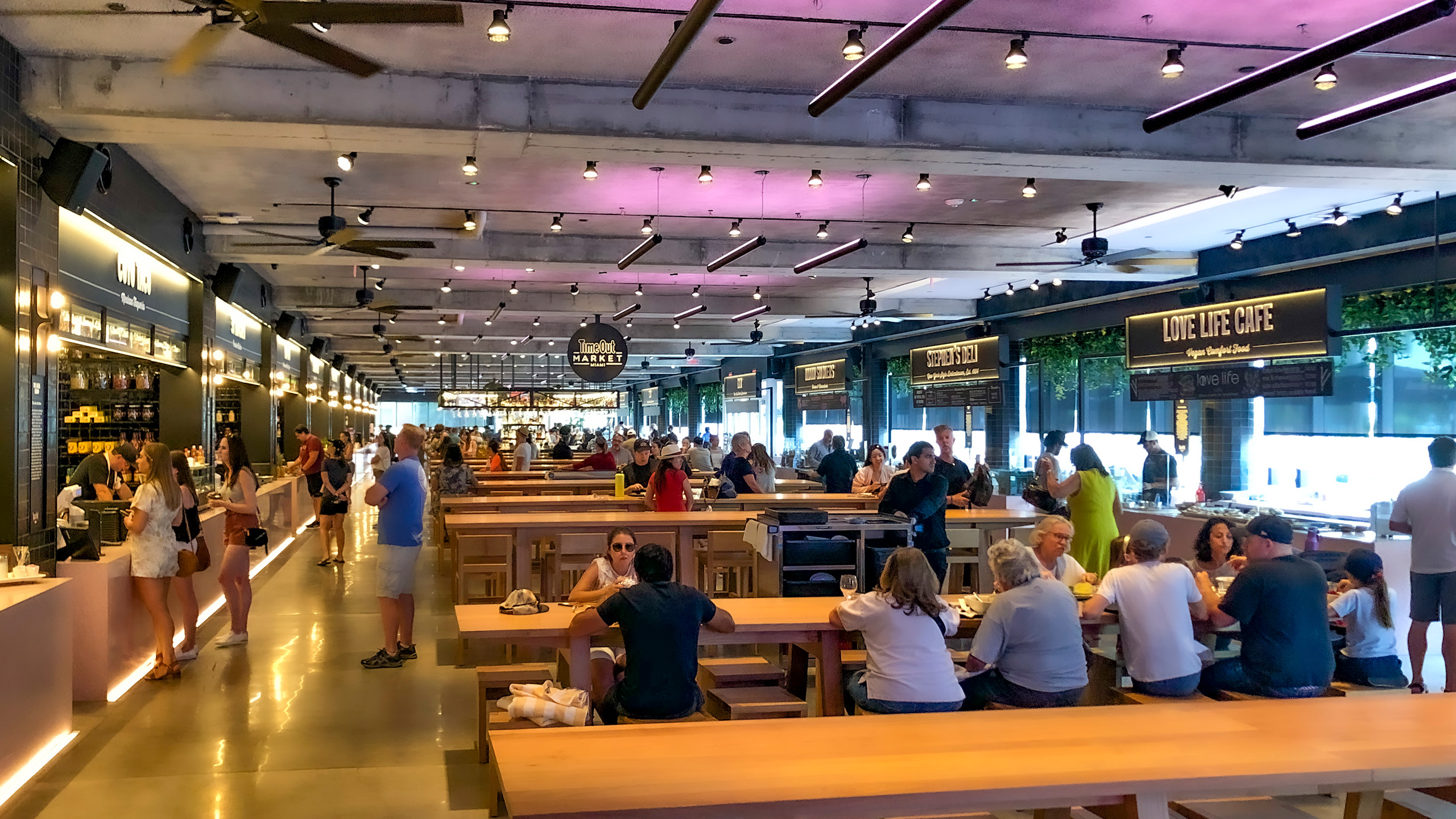
Step 7: Places to Eat
If you're bringing new cuisine to a place, single-crew workplaces are great ways to introduce the locals to your offerings. Normally, food carts, food shacks, food cottages and Third Places come to mind, most of which occur outdoors. The Food Hall shown above is a new type that works best in a large open hall with kitchens on one side, opening onto the dining hall. They work great for introducing the work of local chefs, especially when their main eating establishments are some distance across town because people get acquainted with culinary work they may never have otherwise encountered.
Stay
Principles
The Food Hall above is in Miami Beach on the eastern end of Lincoln Road, so for those who are staying, this one's a keeper.
Go
Principles
The best approach to food as not only nourishment but also economic development in a new place is to start with the outdoor single-crew workplaces to attract the most curious locals, then supplement that with a Food Hall in the central city where more longtime locals can get acquainted with your work.

Step 8: Bed & Breakfast
A Bed & Breakfast is a neighborhood essential because it eases the size pressure on neighborhood homes, as discussed on other Place Recovery pages. This, however, is a unique one: mobile and whimsical cottages arranged in a cottage court. If you're going to a new place, these could be hauled from your earlier home, where they might have been used as temporary housing after the climate disaster that eventually drove you away.
Stay
Principles
A mobile cottage court is not without merit in a place you're hardening to stay because it's a fanciful reminder of the transient nature of life in this climate-challenged place. Doing so can up the edginess quotient of the place substantially.
Go
Principles
Turning your transport to your new hometown into a quixotic B&B is just such a cool thing to do! And there are many great stories embedded in each cottage; just be sure the innkeepers know the stories!

Step 9: Live/Work Units
Seaside's Central Square above was intended as spawning ground for movable shop buildings that could eventually move to the Lyceum at the bottom of this image to become part of the school. Classic live/work units are masonry in most places, but in a place you're staying and hardening as well as in a place you're migrating to, live/work units that can move around town or around your neighborhood are really nimble additions to the urbanism.
Stay
Principles
If you want to use movable live/work units in a place with climate threats, be sure the construction and attachment to the ground are strong and durable.
Go
Principles
Moving buildings around in a new neighborhood you're building should be easier than in existing places because you can plan in advance against impediments like low bridges, powerlines, and such. But be sure to do your homework if you're looking to move some of the buildings into or out of existing urbanism that may have impediments already in place.

Step 10: Neighborhood Market
The market propositions are quite different depending on whether you're staying or going (see below). But in both cases, neighborhood markets where you can walk or bike to daily and weekly essentials are must-haves.
Stay
Principles
The market challenges for those staying and hardening is to help keep the existing ones open.
Go
Principles
The best market type in a new place where development is frugal is a simple market hall with bays for each product type instead of a supermarket that tries to be all things to all people. Not only does a multi-entrepreneur market hall employ more people and spur your local economy, but it can also meet changing product needs more nimbly than a big corporate store.

Step 11: Dedicated Workshops, Offices & Retail
Consider your mobile workplaces, from food carts to movable live/work units to be your urban chess pieces, able to move to locations that serve you best at a particular time. Once they've served you there, from the most mobile types to the more grueling moves of multi-story live/work units, a site may have graduated to candidacy for dedicated and durable mixed-use buildings like those in this scene. In a best-case scenario, build permanent 1-story buildings over which you can slip a pre-engineered building frame supporting several stories above, ideally at the scale of Paris.
Stay
Principles
The biggest challenges for dedicated mixed-use buildings in a place with climate threats are structural. Be sure that the buildings you're building are not only in a raised or otherwise hardened location, but that the building itself is also hardened against the threats of the place.
Go
Principles
Dedicated long-term mixed-use buildings should behave as good neighbors, appearing as if they're native to the place, so study the architecture of the place and the region to be sure that what you're building seems to belong there.

Step 12: Civic Buildings
A civic building, especially in a mature place, should express the highest ideals and culture of its region and its place within the region. This is Randolph Hall, the centerpiece of the College of Charleston, and is a classic expression of these civic building goals.
Stay
Principles
Some architects might design in ways that express the climate threats that changed the hardened place, but is that uplifting or does it induce fear? Fear is not a high ideal, so such a building would fail its mission as a civic building.
Go
Principles
Civic buildings in the neighborhood, quarter, or urban extension where the climate refugees sought shelter generations before should not only express the larger ideals of the region and culture at large, but would be remiss if they did not express in some way the gratitude of those pioneers for being welcomed to make their new homes here.
Search the Original Green Site
Buy the Original Green book on Amazon

Rather Buy Indie?
Contact Sundog Books at Seaside, which is our favorite bookstore ever!
Speaking
I speak on the Original Green across the US and abroad. Would you like for me to speak (via Zoom these days) at your next event?

Got an idea?
If you have an idea for a story, or know about work we need to feature...
Subscribe
... to receive periodic Original Green news releases. Here's our full Privacy Policy, where you'll see that we will not share your info with anyone else, nor will we sell it to anyone. All three fields required.
Home
Origins
Foundations
Nourishable Accessible Serviceable Securable Lovable Durable Adaptable Frugal Education Economy Culture Wellness
Resources
Original Green Scorecard Initiatives Presentations Reading List Quotes Links Tweetroll
Stories
OGTV
Media Room
Bios Press Speaking
© 2021 Mouzon Design, Inc.