
Disaster Recovery
Unlike other recovery types, disaster recovery has no core addiction that causes hurricanes, tornadoes, earthquakes, volcanic eruptions, floods, fires, tsunamis, landslides, avalanches, blizzards, heat waves, and droughts. Some point to climate change as the culprit for some of these disaster types, but unless you're a member of the UN, you're unlikely to be able to do anything about atmospheric carbon, and in no case can you do anything about nature being nature.
Addiction or not, there are strong enough parallels with other place recovery types to fold disaster recovery into place recovery. There are even stronger parallels between disaster recovery types, so even though early steps are illustrated by hurricane recovery steps, they're quite similar across the disaster board.
Three other things set disaster recovery apart: Tornado warnings sometimes come only when the threat is imminent and you have to jump into the strongest source of shelter, like a bathtub. I've had to do that more than once. And with earthquakes, there may be no warning at all. But with most of the other types, many people who can get out do get out once warned. So those who stay behind (we've done that, too, for several hurricanes that didn't seem so threatening) can be a much smaller group than all the townspeople that once inhabited the place.
The other difference is that natural disasters are equal-opportunity destroyers while the other types are more focused. So infrastructure like bridges and roads are almost as likely to be destroyed as buildings, while in Sprawl Recovery, car-serving infrastructure is actually a major symptom of the addiction and is usually in fully functional form when the recovery process begins.
Finally, the few people likely to remain after a disaster for which there was warning are likely to be in a more mentally fragile condition, so steps should be taken early to help begin recovery of the culture of the place so they don't fall into deeper depression as a result of what appears to be the loss of their whole world.
Important Note: We have worked with our colleague LC Clemons on disaster recovery dating back to when we spoke together at the United Nations in 2015. Granted, it wasn't in the Assembly Hall; the Pope was speaking there while we were speaking in the UN Annex across the street. In any case, LC is the source of much of the material on this page. Google her and you'll see why.

The 12-Step Program for Disaster Recovery
Of all the Place Recovery types, disaster recovery is the most time-sensitive because people's worlds have been unexpectedly turned upside down. Unlike the other Place Recovery types, this is the most stripped-down page, focusing primarily on a task list of things to do and with less discussion of theory except when strictly necessary. The illustrations below are for hurricane recovery work in a coastal location. Other disaster type responses should be calibrated to the type of disaster.

Stage 1: Civic Space
The neighborhood square that will grow in intensity through the steps of disaster recovery begins with what is likely a 10-minutes-or-less decision: where to pitch the Red Cross tents or the tents of other first-response recovery agencies. By the time other people are reading this, that decision has already been made and is unlikely to change unless there's strong enough agreement to pull up stakes and move to the better place.
Tasks
Set up tarp tents adjacent to an open area large enough for a small working square (80' x 100' minimum).

Stage 2: Food & Tents
This stage makes food and tents (likely army surplus) available for shelter for locals and the first responders.
Tasks
Raise cooking tent.
Raise tent distribution tent.
Raise food & water storage tent.
Raise dispensary tent.
Replace first responder tents with screen-walled and furnished tents for disaster management.
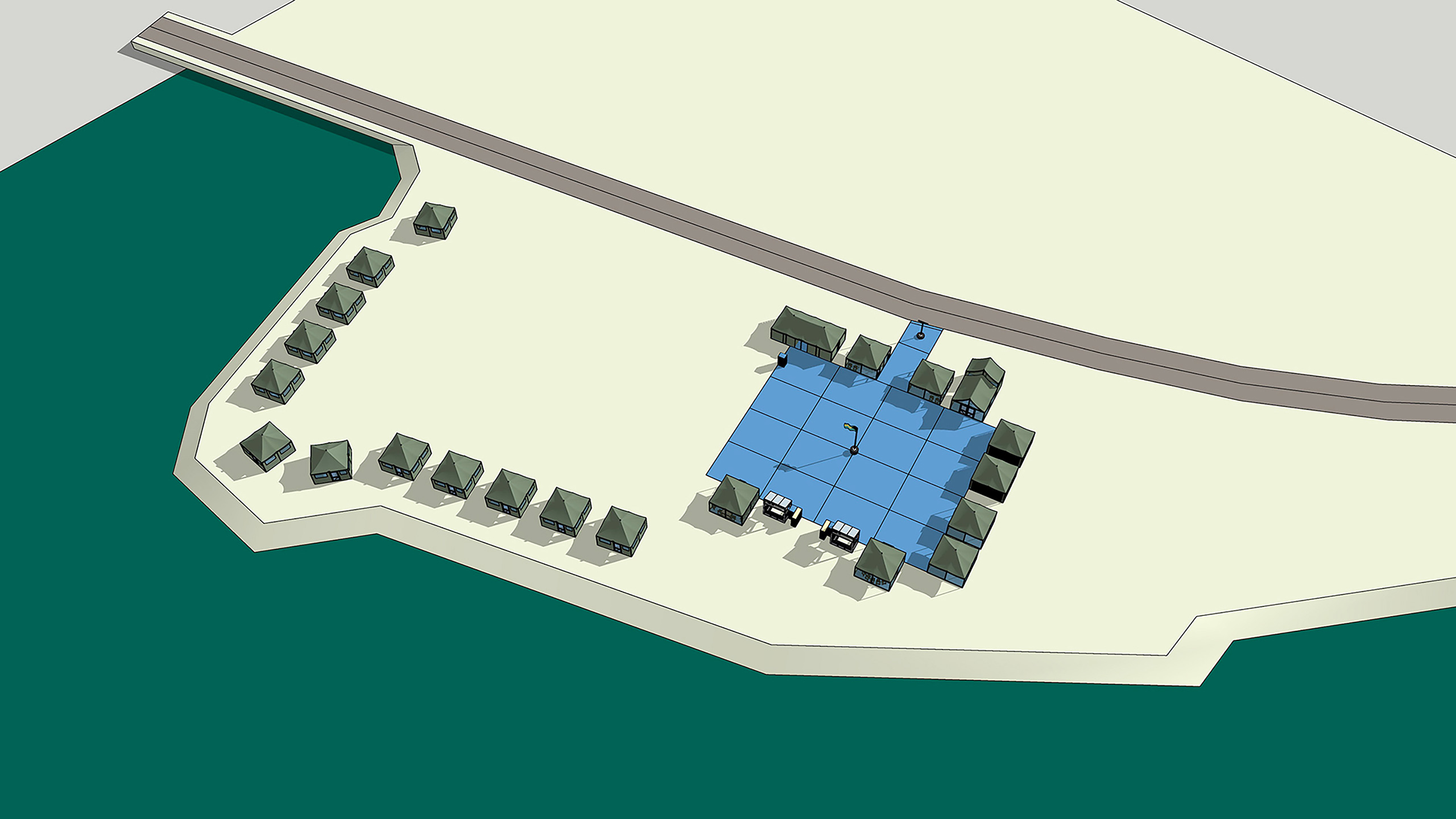
Stage 3: Basic Services
This stage begins basic services beyond food and tents.
Tasks
Spread tarps for working square around which other services of this stage will be arranged.
Start tarp stockpile.
Install rapidly deployable PV solar for boiling water, etc.
Lay out tarp path from working square to crosswalk at street.
Raise daycare tent for children of residents who stayed beyind so they can work.

Stage 4: Beginning of Community
This is the first stage at which, if sequenced well, some residents begin to feel that recovery might be possible; this stage supports that.
Tasks
Raise the flag. Everyone who has ever been through a disaster knows this means "We're coming back!" Actually, someone might have planted a flag in the ground already because IYKYK. If so, do a tire-and-post flagpole and hang it there.
Raise recovery headquarters tent.
Raise assistive Services tent.
Begin workers village of "dorm tents" for several workers each.
Begin tent village for locals of family-size tents.

Stage 5: Hammers Show Up
When workers show up who are equipped to build basic stuff more durable than tents, the serious recovery of community begins. Much disaster recovery is all about infrastructure and buildings, but the recovery of the people who stayed even as their world was shattered really need this stage.
Tasks
Lay out tarps for living square across the street.
Set up open-air grilles.
Start yoga mat stockpiles; they have countless uses in disaster recovery.
Start bike corral for faster transport.
Set up solar water distillation pyramids, barrels, & hand pumps.
Set up first shop shacks to replace kitchen tent, food storage tent & water storage tent.
Assistive services shacks replace tent.
Headquarters shacks replace tent.
Supply bodega replaces dispensary tent.
2 food shacks replace cooking tent (likely 1 hot, 1 cold).

Stage 6: Culture Recovery Begins
This is the stage left out of all conventional disaster recovery sequences, because those focus on rebuilding stuff, but not people. The Living Square is furnished with picnic tables and surrounded by food shacks; it is the place where locals and workers can come for one good meal at the end of the day. Operation of the food shacks is crucial; all food at this point and into the foreseeable future is shipped in, but any locals who worked in hospitality before the disaster should be the people working the food shacks; it's part of building a sliver of a sense of normaly. At this stage, food is free because local banking no longer exists and most of the cash of the place was likely washed out to sea. But in future stages, workers from elsewhere have money to spend, and its infusion is the first step to restarting the local economy, so the food shack workers should be paid for their work. Think normalcy.
The stage is the place where meetings of the entire community are led, but its top function is the beginning of the recovery of the culture of this people and this place. So bring acoustical musical instruments the locals play and find people willing to play and sing at dinner time. Expect a flood of emotion that first evening because long-loved songs of a place can do that, and it might even be more moving than planting the flag. And remember that planting the flag began with a song. If you're old enough to remember when that song came out in 1984, you know what I mean.
Tasks
Build the stage.
Build Living Square food shacks.
Set up picnic benches.
Set up temporary tarp showers (need solar water heaters).
Set up women’s supply shack.
Set up hardware shack.
Set up pharmacy/medical supplies shack.
Set up mental health services shack.
Stage 7: Build Local Community
This stage continues cultural recovery on several counts, some involving the kids so they become partners with their parents in the recovery of their community.
Tasks
Set up town hall/meeting tent.
Repair/build pier (with celebration event of some sort, reconnecting to the water).
Kids start painting shacks.
Shower trucks arrive.
Set up arts shack.
Set up music shack.
Set up food culture shack.
Porta-potties & emptying truck arrives.
Mark kids play area in front of stage.
Plants in pots - edible?
Pop-up library for kids.
Stage 8: Beginning of Local Economy
Small steps leading toward this stage were begun in Stage 6 with the workers in the Living Square food shacks, but money begins to change hands at this stage, thanks to workers from elsewhere who begin the infusion of cash into the newborn local economy. There's one key error conventional disaster recovery processes make: if the disaster occurs in a fishing community like this one, they send fish because they assume fish was a staple of the local diet. Yes, it was, but don't do that! Instead, do everything possible to repair the fishing boats and get them back out on the water again, plying their trade. If not, the fishermen remain victims for the foreseeable future. If out on the water, they become the vanguard of local economy recovery! A night-and-day difference.
Tasks
Repair fishing boats.
Build fish cleaning stands/processing areas for fish & conch.
Build first 15 x 40 cottage shops - 1 for expanded bodega/corner store, 1 for expanded grocery (move shop shacks they once occupied for other uses).
Stage 9: Build Local Economy
The "virtuous tourism" item might sound ridiculous, but consider this: for most people, the first response to a disaster is to send money (which is good) but then forget about it once it falls off the current news cycle in a week or less. But for a small subset of the population, the response is "how can we halp?" If the answer is something like "come be our neighbor for a little while, and join our recovery efforts," there are people who will come. And the task list below calls for a "glamping tent village," but it's not luxurious tents; for these people, the glamor (virtue is a better term) of coming isn't just another resort vacation, so a simple tent that's just a step up from the army surplus tents is fine. And because the place illustrated above is in an oceanfront location, this is the very first step in restarting the tourism economy.
Tasks
Start fishing.
Start cleaning fish.
Set up glamping tent village for “virtuous tourism;” the beginning of tourism again.
Set up craft workshops for local craftsmen, which are shop shacks with a working verandah all around; store stuff in the shack at night and work outside by day.
Set up bank; connect with satellite link.
Stage 10: Begin Disaster Hardening
Disaster hardening in this case means hurricane-hardening (and lifting). For a place ravaged by wildfires, that means rebuilding in ways that resemble how the Spanish colonists built in Latin America: stuccoed masonry buildings and hardscape paving on streets and plazas so there's very little fuel load in town even if wildfires are ravaging all around.
Tasks
Pour raised squares to replace tarps and build boardwalk trenches for walking above andt for storm drainage below; this is the stage where it begins to get permanent.
Stage 11: Continue Hardening
This stage achieves the first two-story structures of the neighborhood center, which could end up being the climax condition of the place, remaining at this scale indefinitely because places that have been through a disaster aren't usually flush with cash for building tall buildings in the foreseeable post-disaster future. And two-story structures have a storm-strong benefit: with a hurricane on the way with an expected storm surge, just move everything on the steel (shipping containers) or masonry (historically) first floor to the second floor, then just hose it out after the storm passes and move everything back downstairs again.
Tasks
Bring in shipping containers for expanded and more durable shops, set cottage shops they’re replacing on top and convert to cottages for shop owners.
Replace tent spaces shop owners are vacating with more permanent glamping structures and add the innkeeper’s house and restaurant.
Plant street trees and trees in other places as needed, making sure to use shade trees well-adapted to the local environment.
Replace meeting tent with 2-story meeting hall which has neighborhood offices on the mezzanine.
Stage 12: Complete Hardening
Tasks
Build masonry walls around containers to elevate to 16’ - 4” above square (28 stair risers, which creates a good retail or workshop ceiling height), then crane shopowners’ cottages up & sheathe with permanent siding.
Search the Original Green Site
Buy the Original Green book on Amazon

Rather Buy Indie?
Contact Sundog Books at Seaside, which is our favorite bookstore ever!
Speaking
I speak on the Original Green across the US and abroad. Would you like for me to speak (via Zoom these days) at your next event?

Got an idea?
If you have an idea for a story, or know about work we need to feature...
Subscribe
... to receive periodic Original Green news releases. Here's our full Privacy Policy, where you'll see that we will not share your info with anyone else, nor will we sell it to anyone. All three fields required.
Home
Origins
Foundations
Nourishable Accessible Serviceable Securable Lovable Durable Adaptable Frugal Education Economy Culture Wellness
Resources
Original Green Scorecard Initiatives Presentations Reading List Quotes Links Tweetroll
Stories
OGTV
Media Room
Bios Press Speaking
© 2021 Mouzon Design, Inc.