It is better to keep an historic building than to demolish it and build a LEED building in its place. Sounds preposterous? Read on...
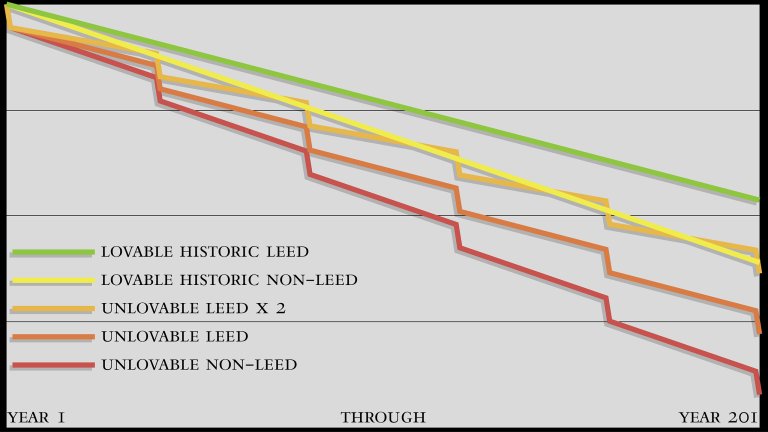
Lovable Buildings are the first essential building-blocks of sustainable buildings. Here’s why: If it can’t be loved, it won’t last. The chart above shows the stunning repercussions. It charts total energy usage, including both the energy of operation and the total embodied energy of new construction (energy to construct plus embodied energy of the materials.)
The yellow line is an historic building no modifications. Because it has been there for a long time, it has demonstrated its lovability. The green line is an historic building renovated to LEED standards. The USGBC said in 2009 that the difference between LEED and non-LEED building (all ratings) saves 25% to 30% per year in energy versus non-LEED buildings, which I used to build this chart. All lines go down... energy used is negative, energy generated is positive. Not even today’s LEED platinum buildings generate as much energy as they use.
The three bottom lines have stair-steps, which is where the buildings are demolished and rebuilt periodically because they are unlovable. This chart shows the unlovable buildings being demolished every forty years. Wal-Marts, as we all know, are lucky to last half that long. And think of all the ranch houses that never saw their fortieth birthday. I used data from The Greenest Living for energy to demolish and reconstruct, assuming demolition of “medium construction” (steel frame,) and rebuilding an office building.
As you can see, LEED buildings that are unlovable are always worse off than unmodified historic buildings. Buildings must perform twice as well as the average LEED building (the “unlovable LEED x 2” line) to be equal to unmodified (but well-maintained, of course) historic buildings. And the green line, which is an historic building modified to perform 25% better, far outstrips them all.
I blogged several weeks ago aboutthe conflict between the preservationists and LEED. There have been several excellent comments on that post... take a look at it, too. But the bottom line is that lovability matters in a big way. And in such a big way, as you can see above, that our best technological solutions can’t dig us out of the energy hole created by unlovability.

