Most solar things today are ugly. This is because most solar equipment is conceived solely as an act of engineering rather than an act of design. Back in the 1970s, during the first green revolution of our lifetimes, millions of “engineering-only” solar collectors were installed in roofs all over America. You’ve seen them, if you’re old enough to remember... big black boxes supported at funny angles having nothing to do with the house design by metal struts. They resembled nothing, really, that we had ever seen before. But if you squinted hard, you might imagine that they looked like giant car radiators supported by something that looked like the underside of the folding bleachers in the high school gym.
But what would such a contraption be doing on someone’s roof? Not to worry; they didn’t last long. By the time the 1980s rolled around, people were saying “get that hideous thing off my roof; I don’t care if it is saving me money. I will not tolerate it any longer!” And so they were taken off by the millions, and either carted off to the landfill, or maybe their copper was salvaged in some cases.
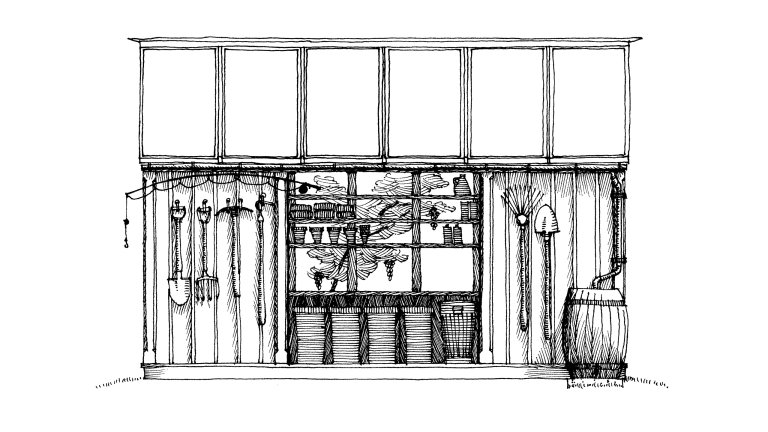
We stand the risk of killing this second green revolution if we don’t start looking at solar equipment as an act of design, not just an act of engineering. Today’s green revolution seems strong, but the one in the 1970s seemed strong, too. But the bottom line is: If It Can’t Be Loved, It Won’t Last. The Green Shed pictured above is my first attempt to show that solar in particular and green in general can be beautiful. Surely there are other architects who can do a much more beautiful job, but hopefully this makes the point.

So what is a Green Shed? A Green Shed is something that you build somewhere in your yard that does several things: It houses your recycling bins and your trash can. It is your potting shed. It contains your toolshed. And it houses your solar equipment and maybe your collectors.
Today, photovoltaic cells are not yet economically feasible in many places where electricity is still relatively inexpensive, but they are clearly on the near-term horizon. So the wisest thing to do is to go ahead and provide a place for the equipment because even if you don’t install photovoltaics today, you are likely to do so at some point in the not-too-distant future. So be prepared.
Hot water solar collectors, on the other hand, will save you money today, so there’s no good reason not to use them. Except that they’re ugly.
This Green Shed attempts to solve that problem by making the hot water collectors become the entire South-facing roof. Don’t worry about getting the exact angle right, because the sun moves all through the day. Rather, get the architecture right for your region, and the angle likely won’t be so far off that the efficiency is hurt that badly.
But why the entire roof? Because even when solar collectors lay flat on the roof, they still are ugly if they form an unsightly blotch on the roof’s surface. But if they occupy the entire roof, then they are simply the roof’s surface. It’s a completely different perception. But how does it work? See the dashed line just below the solar collectors on the drawing above? That’s the actual roof surface where the waterproofing is, because a little water might drip between the collectors. The space between the roof and the collectors is ventilation space.
And here’s how the plan works: There are two lockable rooms on either end of the Solar Shed. Whichever of the two is closest to the house should be the solar equipment room. The other one should be for your more expensive garden tools. Tools and materials that aren’t worth so much should be hung on the exterior walls where they are more convenient to use. The space between the two lockable rooms forms your potting shed and your recyclable and trash storage below the potting bench.

