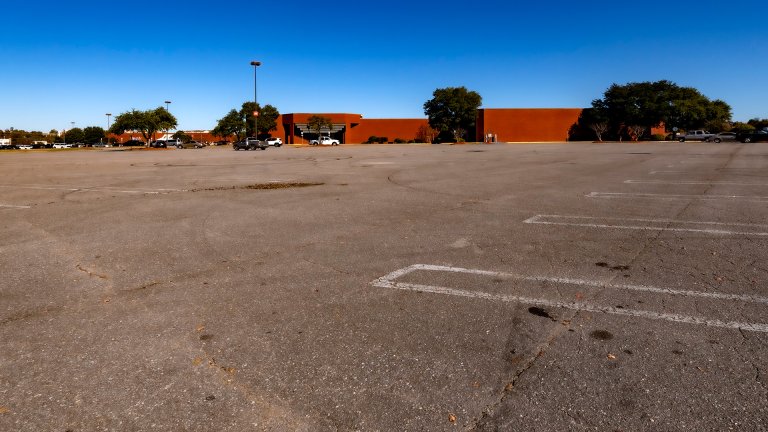
Take the Black Friday Challenge today; here's how it works: While you're out today doing your patriotic duty as a consumer, don't forget to look at the parking lots, and take pictures of all those empty spaces in the back quarters of the lots. Parking spaces left empty today will never be parked in forevermore by customers of that shopping mall or strip center.
The top reason for this is the egregious municipal off-street parking requirements imposed since the 1950s which have resulted in roughly 8 parking spaces in the US for every car, SUV, and pickup truck in the country. The second big reason is more recent: online shopping has dramatically reduced the number of people going to bricks-and-mortar stores today.
Meanwhile, we have a housing crisis. The US has +/- 2 billion parking spaces for those 250 million vehicles noted just now. Redevelop only a quarter of that parking (+/- 4 million acres) at just 20 units/acre of beautiful mixed-use places = 80 million housing units. That would meet our housing needs in the US for decades into the future.
So here are the subsequent steps after you take those parking pics today:
Analyze the places you shot. Look not for dead malls or strip centers because that'll paradoxically be a tougher task. You want to work with places with most of their stores still doing reasonably well, but with a lot of empty parking spaces today.
Get LandGlide or a similar app to help you easily identify the landowners of your target properties. Your pitch to them will be: "let's look at a proposal for turning your forevermore-unused parking into a redevelopment asset that can be transformed into a mixed-use pocket neighborhood, otherwise known as 'built-in customers for your existing stores.' And the mix of uses will be of a scale far too small to compete with your stores; it'll be closer to WFH (Work From Home) scale. So you're taking real estate with no economic activity except the cost of seal-coating and re-striping the asphalt periodically and transforming it into an income-producing asset that benefits your other businesses."
But before meeting the property owner, you need a plan. If you're a designer or builder, you may be able to do this yourself, or if not, you probably have consultants who can. But if this seems like a great idea but you don't know anyone who can do a plan, groups like Strong Towns and the Incremental Development Alliance have robust local and regional networks. You might also consider members of the Urban Guild which I co-founded with Nathan Norris in 2001 and which includes some of the best designers of architecture and urbanism in the country, including Andres Duany, one of the founders of the New Urbanism. If you need help on the development side, the National Town Builders Association people have been developing excellent urbanism for years.
The plan itself shouldn't be brain surgery; you'll likely have a mostly-rectangular site with easy access from an existing thoroughfare already serving the shopping center. The biggest key will be the building units you use. In order to fit most seamlessly into the existing parking lot, consider that parking spaces are roughly 18 feet deep: that's your key metric. We learned back in the Katrina Cottage years that we can design many good units that are 14 to 18 feet wide or deep. Use buildings in this size range and the plan will be more likely to fall easily in place.
Build a toolkit of your best plan types because you don't want to repeat the same building endlessly. As a matter of fact, it would be really cool if people who accept this Black Friday Challenge were interested in sharing their best plan types. If so, I'd be happy to host them as resources on this site. And since I'm advocating sharing, I'll go first. What follows in a subsequent post is a 3-story building type with 4 upper units sharing a stair and work spaces opening directly to the sidewalk. This qualifies as a 3-story walk-up building, which meets code pretty much anywhere in the US. And it works out to around 100 units per acre net plus the working space on the first level, which is a lot more intense than the back-of-the-envelope solution to the housing crisis noted above.

