Urban forestry has lots of useful information to offer, but there is a big lie at the heart of the majority of the work of urban forestry which threatens to discredit the entire discipline if anybody will call their hand on it. It’s the Root Zone Myth.
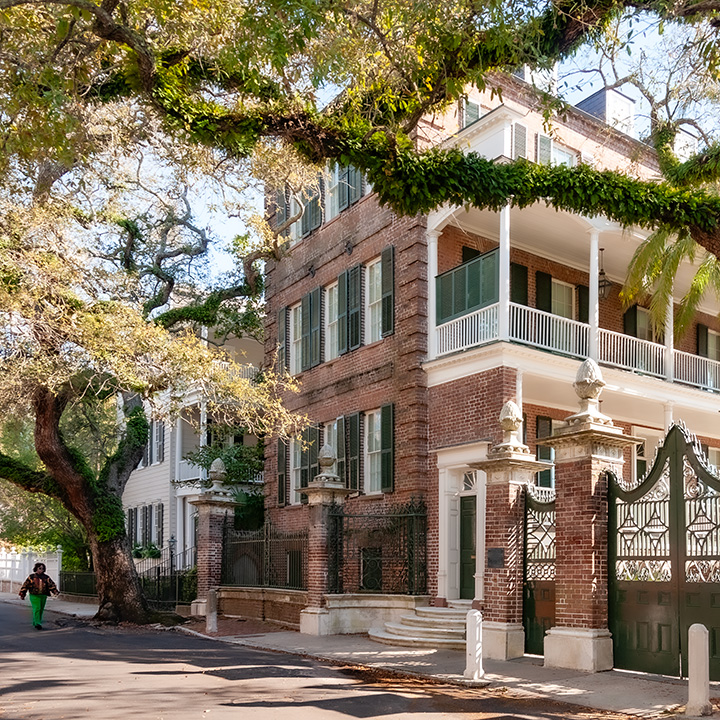
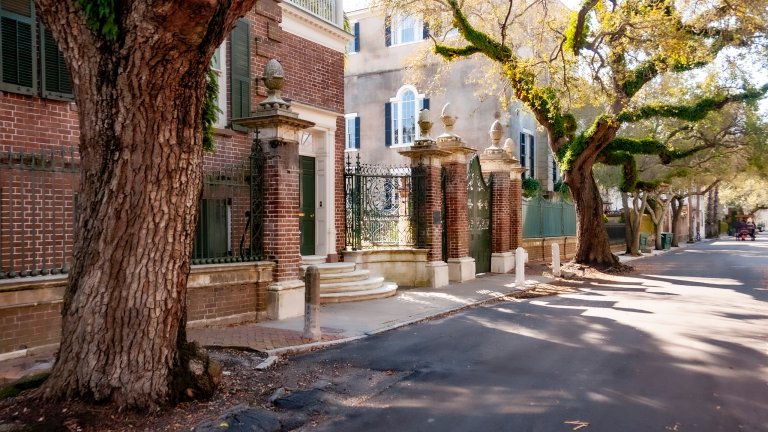
Charleston tree planted in street
As with any myth, there is some kernel of embedded truth. In the case of the Root Zone Myth, it’s the fact that, left alone in a field, a tree’s roots will spread about as far as its drip line, which is the outer limit of its leaves. So if the tree’s limbs and leaves were 40 feet in diameter, its root system would be, too. Now, the urban foresters are saying that’s not good enough; a tree’s root system actually extends 2-1/2 times as far as the drip line. So for that tree with a 40-foot canopy, the roots actually extend to a 100-foot diameter.
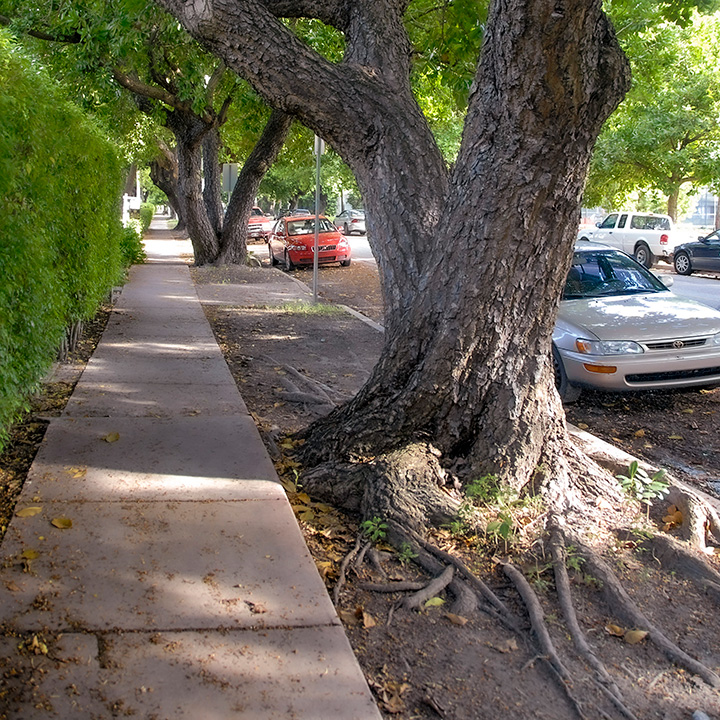
Left alone in a field, this is generally true for many species of trees. But in town, it’s a myth. Nearly every discussion with an urban forester begins with their declaration that we need to protect the drip line, and that no hard surfaces (paving, sidewalks, etc.) can be permitted within the root zone. They say that if you plant trees near paving, the tree will be “stunted,” or “dwarfed.” Do the trees in the image above look serious stunted to you? But look... paving gets to within 3 or 4 feet of their trunks all around them! How can this be? The urban foresters claim that this is impossible, but I took the picture myself in Charleston, and I can vouch for the fact that it is indeed real.
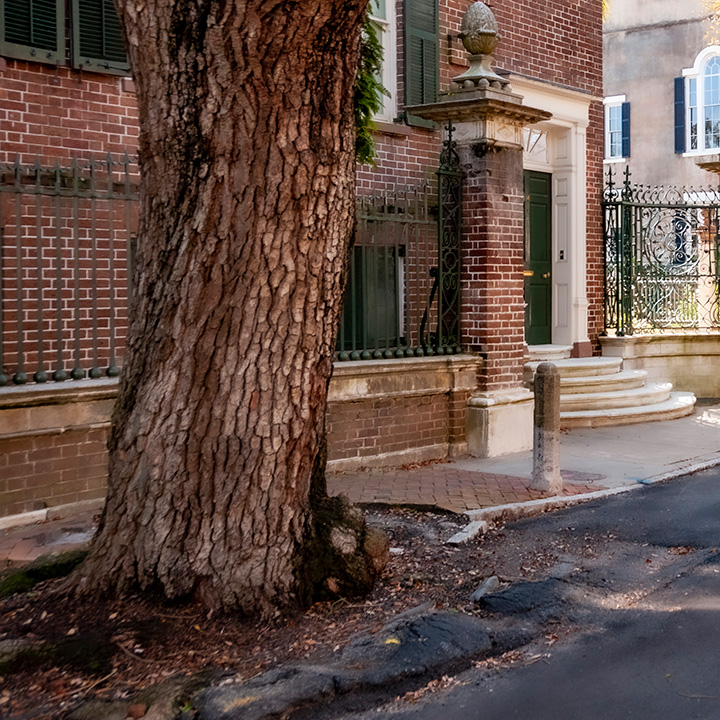
a closer look at this tree - yes, that is asphalt paving all around the tree
The Root Zone Myth becomes the Grand Lie of Urban Forestry because the urban foresters really should know better, but they keep repeating the Root Zone Myth while totally ignoring the urban context.
How do they get away with this? They start by telling stories of trees that have had intrusions into their root zones, and parts of the trees have died in response. The stories are true.
But what they’re not telling you is that these are old established trees. Of course they’ll be stressed and drop some leaves when a significant portion of their roots are destroyed! But the trees in question are the new ones that they want to prevent you from planting along the street, or in the medians of avenues or boulevards. According to many of them, the tree will only grow as large as the unrestricted area for root growth. The fact is that if soil compaction outside the angle of repose of the street compaction is kept to a less compact standard suitable for sidewalks, the new street trees will do just fine.
clear evidence that the lie is really a lie
I was in an audience last night where an urban forester and his city and county planner colleagues made all of these allegations, and more. On the one hand, they were alleging that tree roots don’t grow under paving. On the other hand, they were complaining that tree roots that grow under sidewalks buck the sidewalks up over the years. You can’t have it both ways, guys! Pick the narrative, the truth of which can be verified by walking outside and looking around.
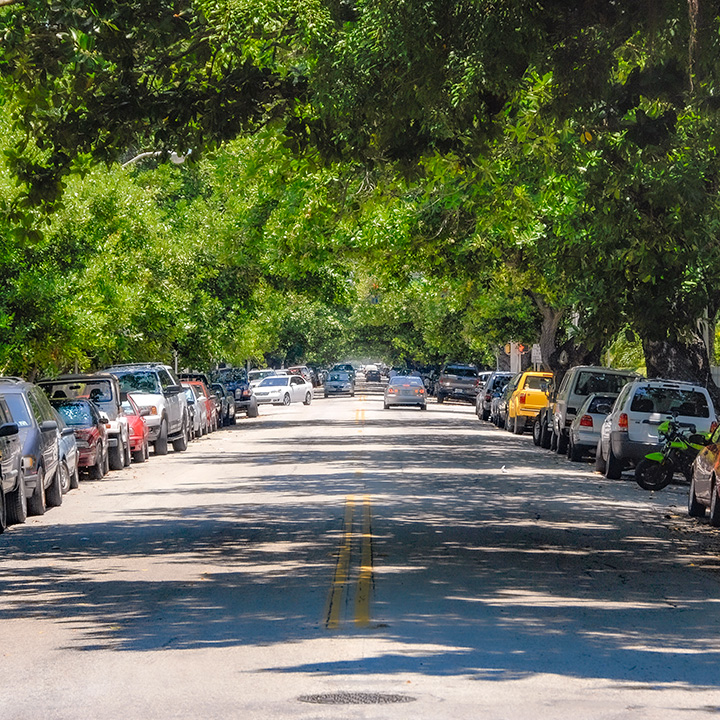
Let’s look at it this way. If, as they said, tree roots don’t grow under paving, and the tree canopy will only grow as large as the roots, then canopy streets would be impossible, because if the branches won’t go further than the roots and the roots won’t go under the street, then the branches would never grow over the street. But the best canopy street in Miami Beach is Meridian, which is pictured here, and which was only a few blocks from the room in which we were sitting as they made these allegations!
Meridian Avenue, on Miami Beach
I don’t know precisely where the roots of the trees in this picture are going, but the branches are clearly going far out over the paving. And this is exactly the sort of street that the urban foresters are saying can’t be done. Worse, if they have their way, they won’t allow you to build it this way. Rather, they’re looking for super-wide swales where the trees are far back from the pavement. Do we really want to outlaw canopy streets like Meridian Avenue?
Here’s another question: what does any of this have to do with sustainability? In a hot and humid climate, it’s very important to be able to shade the sidewalk as soon as possible so that it’s more comfortable to walk there. Walkability, as this blog has said many times, is essential to sustainability because a place isn’t green if people have to drive everywhere, no matter how many green points you get for the buildings.
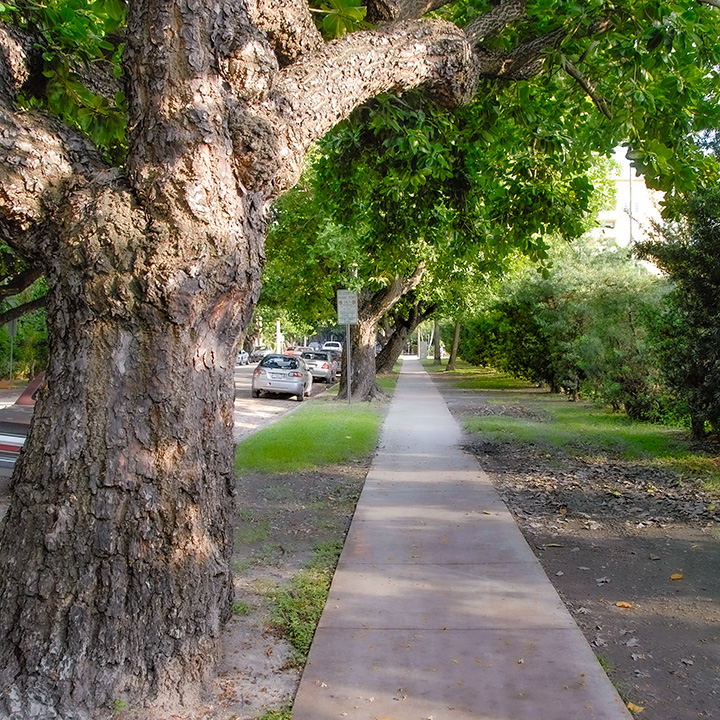
Meridian sidewalk
Placing trees far back from the sidewalk in oversized swales may delay shade on the sidewalk for several years, transforming what should have been a pleasant walk into concrete that seems hot enough to cook an egg. The bottom line is that the Grand Lie of Urban Forestry doesn’t just dismiss canopy streets, which are typically the most beautiful streets in town. It also helps to make the neighborhood far less green by inhibiting walking, which is one of the foundations of sustainable places.
To the urban foresters: With all due respect, you guys really need to dispense with the Grand Lie. It’s destroying your credibility with those of us who choose to observe real life conditions, and to think about what we’ve seen. Because what we’ve seen makes shambles of your Grand Lie. Just walk around town. Just about any neighborhood built before World War II will do, because before then, we knew how to build excellent urban streets, and how to plant the street trees. Observe those trees, and how they live in an urban setting. A city is not an open field. You guys could do a lot of good with all the things you know about trees if you’d just get rid of the Grand Lie and apply all of your knowledge to the urban setting.
To really get this started in the right direction, you might consider changing the name of your discipline from “Urban Forestry” to something else. Why? Because there aren’t many forests in the city. That may be the core of your problem: you’re confused about your own identity, and you’re acting more like a forester than an urbanist. Forestry happens in the forest. Urbanism happens in the city. Call yourselves Urban Tree Managers or something... I don’t really care, so long as you let us build great streets and sustainable places again.
~Steve Mouzon

