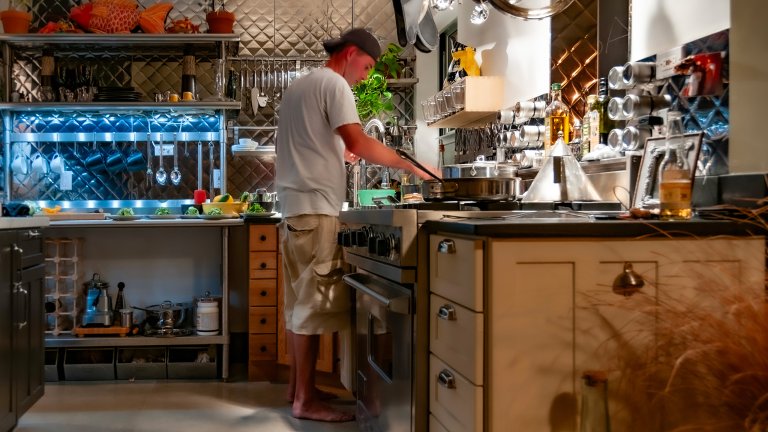
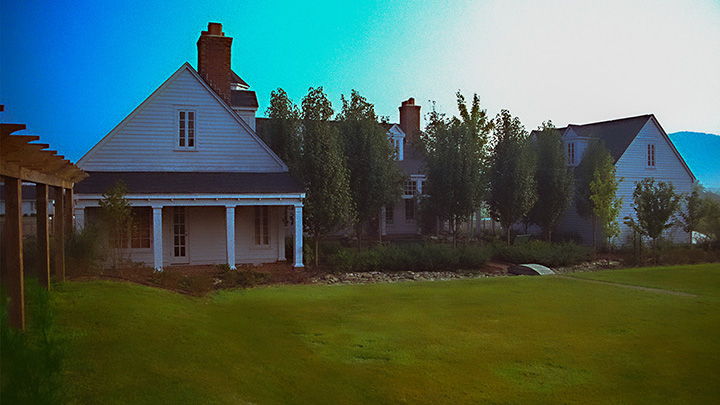
Americans have endured the Poverty of Large for far too long; it’s time to return to the Luxury of Small. That’s my son Sam above, a newly-graduated chef from the Culinary Institute of America in Hyde Park, New York, cooking in the kitchen of our tiny condo on South Beach. It’s a far cry from this house, which is where he and his brother David were raised.
It was four times as large as our condo. It sat on one acre of land which was designed to be a self-sufficient homestead. I described it in some detail in this post on The Trouble With Consumption. We made all sorts of sacrifices to finish the house, and were never able to really finish it out the way we would have liked because the square footage stretched our budget to the limit.
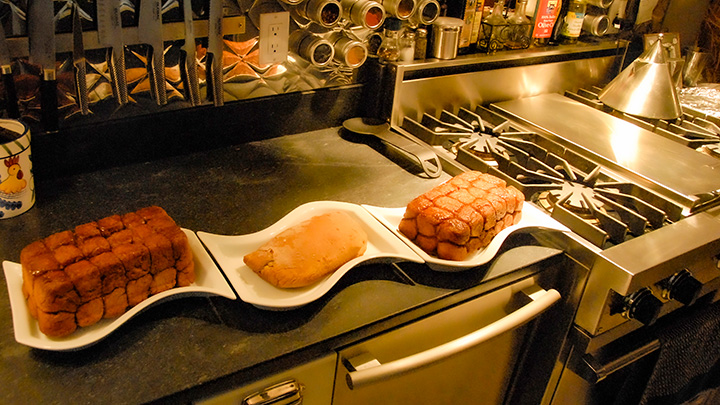
Fast-forward twenty years. Our condo is 747 square feet, as opposed to the 3,000 square feet of the big house. The countertops are soapstone instead of the big house’s cheapest possible white ceramic tile on plywood. The kitchen walls are pleated stainless steel instead of the sheetrock of the big house. I could go on, but you get the idea. Did we suddenly hit the lottery? Not at all. The reason we were able to finish the condo out so much better was because there simply wasn’t that much of it. Because everything was smaller, everything could be better. Small is the new luxury. Without being this much smaller, we’d have never lived in a place this much better.
America’s Urge for Big in recent decades is in many ways responsible for the Meltdown. There were other factors, of course, but consider this: Just before the Meltdown, the average American house size had grown to over double what it was at the end of World War II. Yet the average household size had shrunk to almost half what it was at the end of the war. In spite of the fact that half as many people were inhabiting houses twice as large, we still had so much excess stuff that didn’t fit that we’d made the mini-storage industry a $17 billion/year business!
Let that sink in a minute. The cost of storing all that over-consumption had grown so large that the mini-storage industry had grown larger than the entire movie industry! And these weren’t the things we needed, either... they were the things we really didn’t need... otherwise, why would they be in storage?
All that over-consumption came at a great price. Once, buildings were built for the ages. At the Meltdown, construction quality had become so shoddy that pieces of houses could regularly be found falling off in the driveway in less than ten years! We had become a nation of throw-away buildings and throw-away places. Obviously, we can never become sustainable if we keep throwing stuff away like this.
Houses that were too big contributed directly to the throw-away building culture. How? Houses that have to be built as cheaply as possible because they’re being built as large as possible aren’t really worth saving. And so when the too-big maintenance bill on the too-big house hits too soon because it was built too cheaply to last very long, the easy answer is to discard it and start over somewhere else. And so the throw-away cycle continues.
Do this test: Drive around town randomly. Stop every five minutes and look to your left (or right... it doesn’t matter.) If the building is a house, chances are its age is less than forty years. If it’s a Wal-Mart, on the other hand, chances are its age is less than fifteen years. You’ve probably noticed that people live longer than forty years most of the time. This means that on average, we’re burdening the American public with building more than one house per lifetime, and re-building their retail several times in a lifetime.
We simply must lay down the burden of over-building, because it has become too heavy for America to bear. Let’s unburden ourselves by building smaller, so that we can afford build to last once again. Because we can’t build to last if we build too big. Build big or build well... that’s the choice. We cannot afford not to build well anymore. This has become increasingly obvious recently, and many of the lessons we learned fostering the Katrina Cottages movement have led to all sorts of cool ways of building smaller and smarter.
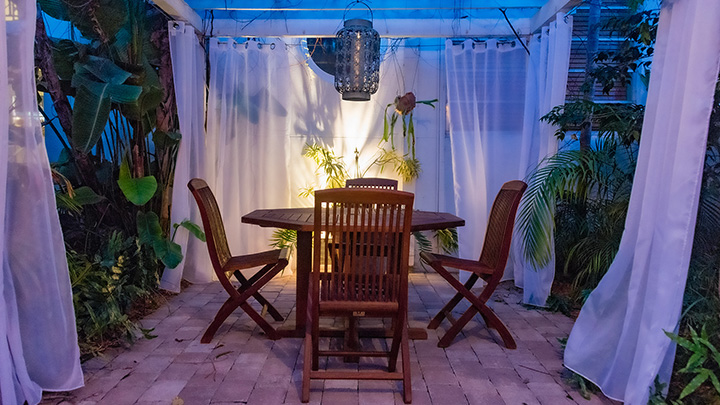
Here’s one really cool thing you can do to reduce the size of your house: build outdoor rooms. They’re not only much less expensive to build per square foot, but they have a hidden benefit as well that you might not have realized: If your outdoor rooms are enticing enough that you spend a lot of time outdoors, you become acclimated to the local environment and need less conditioning when you return indoors.
Creatures of the A/C might say “I could never do that.” I was once one of you. But then I moved to Miami, where I spend lots of time outdoors walking, and in my garden. I can accurately say that I’ve never been outdoors here in the shade and with a breeze when I’ve ever been uncomfortable. And this is in a town where the basketball team is named the “Heat.” Creatures of the A/C come down here and suffer, sweating profusely all the time. But not me. My garden and my walkable town have taken care of that... I’m Living In Season. Build small and well, and build outdoor rooms... this is where real sustainability begins.

